Fubica pointed me to an interesting service today which I believe is an exciting exploration of business models that leverage commons-based peer production.
The service is FON, "a community of people making WiFi universal and free", accordingly to the website. The principle is that people buy a sharing-enabled router which has one secured channel (isolated from the owner's) that anyone participating in FON can use to access the Internet. This way, if you share some of your WiFi, you get access to other people's. An extra feature is that the resulting wireless network can be accessed by people not participating in FON, through a fee. The revenues of these accesses are shared between the FON company and the owner of the WiFi spot used.
What I find most exciting, however, is FON's business model. They are not the providers of the WiFi service themselves. Instead, they facilitate it by building the necessary technology (the WiFi routers) and provide an authority which eases access control, allocation of the exceeding resources (which always have a market potential) and billing.
However, I think what is new here is the type of the system and maybe the extent where this business model is being applied, and not the business model.
Looking at a bigger picture, providing enhanced governance for peer production systems is already being explored as a business model. After all, someone does profit from websites like digg and flickr. Thinking a bit more, money is spent to have Planetlab administrators running security among other aspects of the shared platform.
Considering these possibilities in a same framework opens some interesting questions: When is the service provided by an external (centralized?) entity necessary to enhance peer-production systems? How does introducing the economic valuation of the shared service affects the perception contributors have of the system and therefore their behavior? How sustainable is sharing in such conditions, as users start go game the system and try to profit from it?

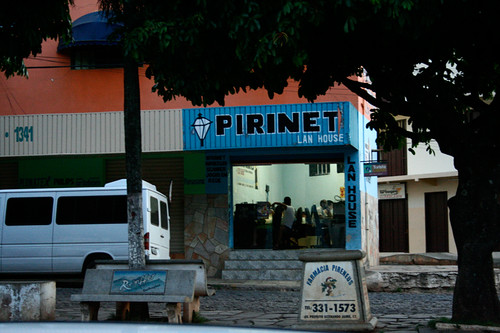
Lan-houses -- small establishments which provide paid access to the Internet and to some software (like text editors and games)--, are huge in Brazil, specially among the low-income population. The Brazilian Internet Committee estimates 30% of the Internet access in Brazil is done through lan-houses [pt] and it as been reported Rocinha [en] alone has over 100 lan-houses.
Furthermore, being attended by so many people on a regular basis, lan-houses have become community-gathering spaces. Ronaldo Lemos [pt] reports how, for example, children birthdays are commonly celebrated in lan-houses these days. Both him and Antônio Carvalho Cabral, both which participate in a project examining in detail the universe of lan-houses, have been active voices on defending these small enterprises and their potential for social inclusion.
So, after reading an article on SciDev about podcasting on poor regions and thinking a bit on what could Brazil and its lan-houses learn from that, I've come up with a project idea and thought it'd worth writing it down to register it.
The idea is simple: what if we could enable lan-houses as media-producing centers where the population could very easily record podcasts or videos with local news or art. Now sum to that a simple system (maybe based on YouTube) through which people could vote for the most interesting media available on that community. Then maybe CD-RWs or DVD-RWs could easily be used to have selections of this media circulate periodically in the community, giving the community frequent access to its own voice and maybe strengthening its cultural identity.
A recently launched effort called scientists without borders is trying to ease networking between scientists in poor countries and their fellows worldwide.
This certainly has the interesting potential of peering scientists in developing countries with people in the centers of excellence in their fields around the world. Nevertheless, I think there are exciting possibilities also in easing developing-world researchers to discover each other. At least in computer science, it happens often that most research we have access to is that which is legitimated in US conferences, where US-made research prevails.
I believe increasing acknowledgment of research being done in countries which have similar issues can allow new initiatives and approaches which have a genuinely developing world perspective.